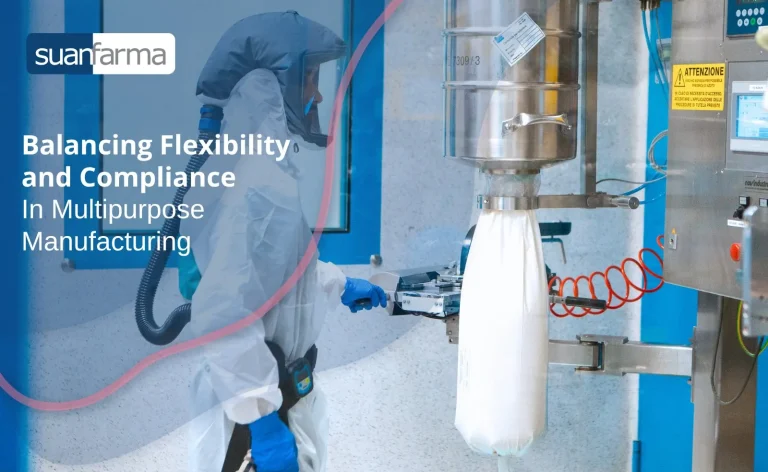
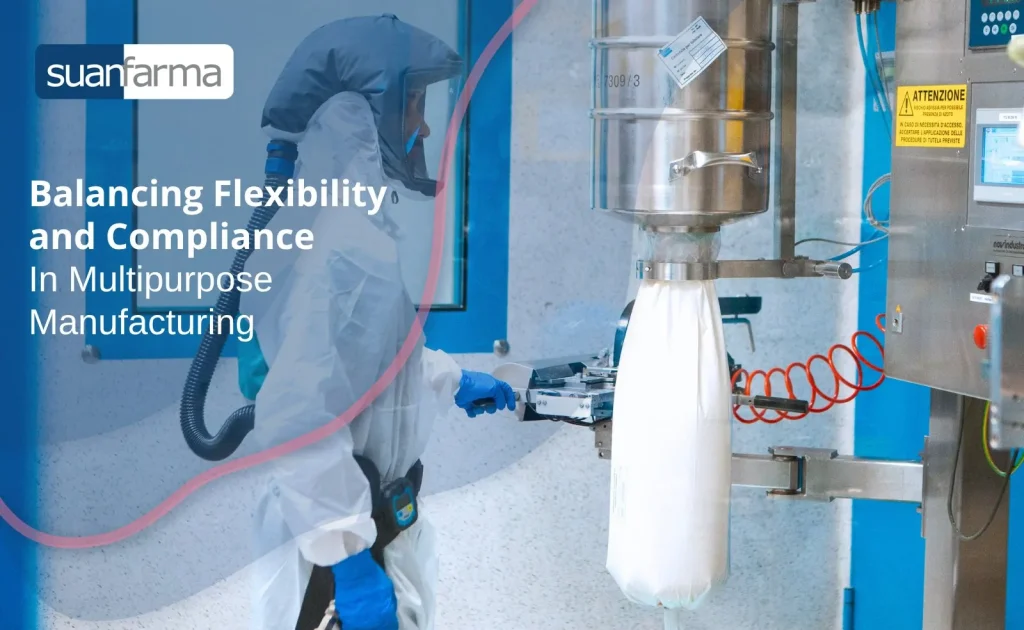
Nowadays it is easy to notice that the pharmaceutical companies have to face every day with new challenges, due to the intensification of the Authorities’ requirements. These challenges may appear very tough to be faced, especially for companies, like Suanfarma, which behaviour is focused on excellence and continuous improvement. Today, with the recent revision of EU GMP Annex 1, the focus is more than ever on the impact of the control strategy on shared facility (i.e. multipurpose).
Very often the shared facility represents a solution for the pharmaceutical companies that want to meet the productivity goals with a versatile production. An old-fashioned vision of the manufacturing sites led us to imagine that every single facility should be dedicated to the production of a single product. For a structured company, this is far away from the best solution.
A shared facility is an approach that allows to manufacture different products using shared production equipments. Although it may represent a great advantage for the company, the shared facility strategy requires a broad knowledge of the processes and of all the related risks. Indeed, the main risks associated to a shared facility are related to the cross-contamination. Through the study and the assessment of an adequate cleaning approach it is possible prevent any risk of such kind of contamination. In fact, an effective cleaning of the equipment is essential to reduce the risk of contamination, and this goal can be achieved only through a validated cleaning procedure.
According to ICH Q9 guideline a quality risk management approach can be considered suitable to prevent the contamination risk. Not all the manufacturing processes share the same issues and accordingly the cleaning processes should be set in order to contemplate the different levels of risks of contamination for each single manufacturing pathway. The challenge is even more tough if we consider that the assessment of the risks related to the cross-contamination in shared facility should be focused on the toxicological and mutagenic profile of all the substances involved in the manufacturing processes. For each cleaning process a broad scientific evaluation should be performed to evaluate what are the acceptable residue limits for each substance and to set an appropriate testing strategy.
It is very clear that to set a Contamination Control Strategy that can be considered acceptable for the worldwide Authorities is a very hard challenge to manage. Suanfarma can face this challenge everyday thanks to its deep knowledge and to its continuous improvements to reach the excellence. This is only of the challenges that we, as Suanfarma Group, can face and win.
Vanesa Vila Kasjan
Head of RA API